

HOME / PRODUCTS / TAMARA® / RESOURCES
TAMARA® Specifications & Resources
A benchtop solution for lipid nanoparticle formulation
This page comprises in-depth details about the TAMARA® microfluidic nanoparticle mixer to help you make an informed decision about the next steps in your RNA-LNP research and development.
Read on for more information about the TAMARA® working principle, unboxing, standard protocols and specifications.
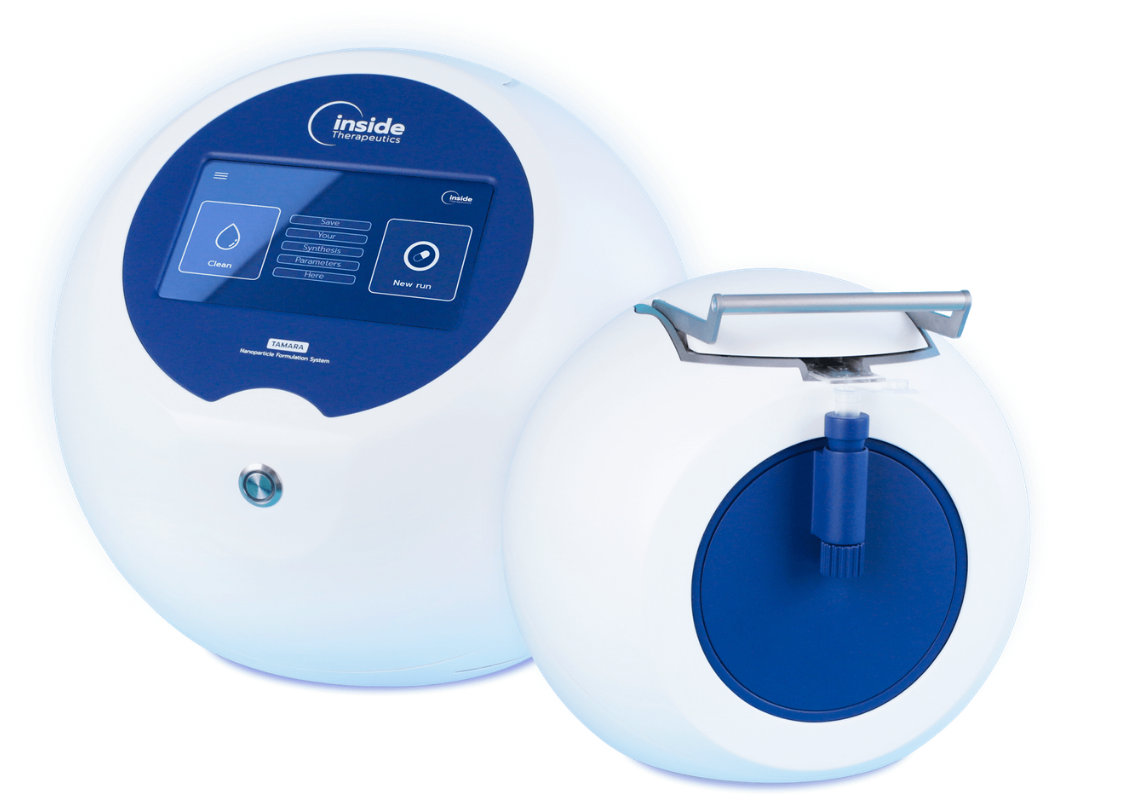
TAMARA® Working Principle
TAMARA® is designed for straightforward use, enabling both new and experienced users to achieve reliable, high-quality results in minutes. Set up and run your nanoparticle formulation experiment in less than 2 minutes—even on your first use—by following three simple steps:
- Set your parameters
- Pipette your sample
- Start your run

Unboxing
See how TAMARA® operates and what your initial setup will involve—watch the unboxing video to get started.

User Manual
Access the TAMARA® user manual for step‑by‑step operating guidance, clear instructions, and recommended best practices.

Standard Protocols
Get a clear overview of using TAMARA® with our standard RNA–LNP formulation protocol, plus performance data for common lipids.
TAMARA® Specifications
Discover the full potential of TAMARA® — read the brochure for key information.

| Inlet Volumes | Depends on reservoir size |
| Achievable Volumes (accuracy & repeatability) |
0.2 to 30 mL Accuracy and repeatability ensured on 0.5 to 5 mL range with the first chip run |
| TFR (total flow rate) |
0.8 to 15 mL/min Depends on input parameters (pressure, volume,...) to ensure best accuracy and repeatability |
| FRR (flow rate ratio solvent:water) |
1:1 to 1:10 |
| Liquid Compatibility | Any aqueous solution & solvent compatible with the wetted materials (Topas/COC and PEEK). |
| Optimal Initial Lipid Concentration | 1 to 10 mg/mL Can accommodate initial lipid concentration up to 100 mg/mL |
| Inlet Gas Pressure | 8 to 10 bar (120 to 150 psi) Lower pressure inlet can be accommodated but would decrease maximum accessible Total Flow Rate and cleaning capabilities. Only use dry and non corrosive nor explosive gas. |
| Operating Temperature | 10°C to 40°C |
| Humidity Range | 0 to 80% relative humidity |
| Dimensions (height x width x depth) |
Synthesis module: 23 x 26 x 23 cm Controller: 31 x 34 x 36 cm |
| Weight | Synthesis module: 3.650 kg Controller: 5.050 kg |
| Power Supply | 110-220 V 45W |
| Frequency | 47-63Hz |
| Neutral System | TT |
| Level of Pollution | 1 |
| Device Class | IP20 |
| Overvoltage Category | II |
| Device Protection | 3 |
| Special Atmosphere | No |
| Installation Altitude | 0 - 2,000 m above zero level |
What Can TAMARA® Do?
Formulation
Lipid nanoparticles (RNA-LNP)
Liposomes, micelles, polyplexes
Polymer & hybrid nanoparticles
Peptides nanoparticles
Payloads
mRNA, saRNA, circRNA, siRNA
CRISPR-Cas9
ASOs & DNA
Small molecules & peptides
Applications
Preventive and therapeutic vaccines
Gene editing & rare disease
Oncology
Personalized medicine
RESOURCES
Articles - Nanoparticles Reviews
Learn more about lipid nanoparticles and formulation methods with the following articles.
- Complete Guide to Understanding Lipid Nanoparticles
- LNP Synthesis: Overview of the Manufacturing Methods
- A Guide to RNA-LNP Formulation Screening
- The Role of Lipid Nanoparticle Compositions
- Microfluidic Synthesis of Lipid Nanoparticles
- TAMARA® Application Note
- LNPs vs Electroporation for CRISPR-Cas9 Delivery
- Why Delivery Remains One of the Biggest Challenges in CRISPR Research
- Benchmarking LNP vs Electroporation for eGFP RNA and CRISPR-Cas9 Delivery in HSCs