

Microfluidizer® Interaction Chambers™
Microfluidizer® Processors are advanced high shear fluid processors that use forces of shear, impact, and occasionally cavitation to emulsify liquids or to deagglomerate and disperse solids into liquids. This is achieved through high energy intensity within the Microfluidics patented Interaction Chamber™.
Microfluidics builds Interaction Chambers™ to the highest standard, anticipating that you will push the equipment to its limits but need consistent, high-quality product output.

.webp "chambers")
Benefits of the Interaction Chamber™
- Durability: the Interaction Chambers are made from stainless steel with interiors of poly-crystalline diamond or aluminum oxide ceramic for long life.
- Uniform and Repeatable Results: Every part of the product experiences identical high shear processing conditions, resulting in small, uniform particles with tight particle size distribution.
- Completely Scalable: The process is continuous and scalable from lab to production scale.
- High Shear Performance: Higher and more consistent shear rates are achieved compared to other technologies, with fluid velocities up to 500 m/s.
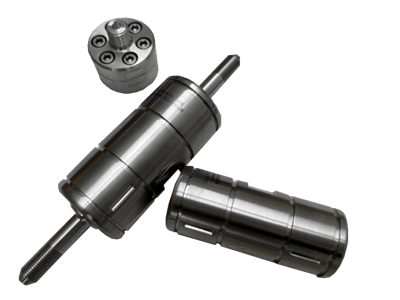
How Interaction Chambers Work
The Microfluidizer processor acts as a powerful pump, forcing material formulations through micro-channels in the Interaction Chambers at pressures up to 30,000 psi.
Acting as a continuous flow microreactor using turbulent mixing, localized energy dissipation, impinging jets, and fixed geometry a uniform pressure profile is created, resulting in accurate and repeatable particle size distributions.
The patented Interaction Chamber™ ensures every microliter of product receives the same treatment, using fixed geometry micro-channels as small as 50 μm.
Interaction Chamber Types & Applications
Microfluidics offers two core designs of Interaction Chamber, each optimized for specific processing needs to ensure you have the right chamber for your application. Please speak to our team to identify which chamber is best suited to your application.

Y-Type Interaction Chamber™
Y-type Interaction Chambers are primarily used for oil in water nanoemulsions, liposomes and polymer encapsulations.
Microfluidics Y-type chambers are available with a microchannel range of 75 to 125 μm with shear rates optimized for each application.

Z-Type Interaction Chamber™
Z-type Interaction Chambers are used for cell disruption, water in oil nanoemulsions, dispersions and de-agglomeration.
Microfluidics Z-type chambers have a range of microchannel dimensions from 87 to 1000 μm.
How the Interaction Chambers enable Scale Up
Scalability from Labscale to production by placing Interaction Chambers in single and parallel.
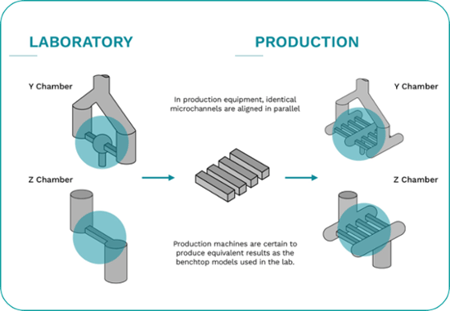
The Interaction Chamber is a fixed geometry component that generates controlled shear and impact forces and cavitation effects. As material passes through the chamber, every element experiences the same processing conditions.
Lab scale research is performed using single-slotted Interaction Chambers with a single microchannel.
Large scale production or continuous processing is achieved by placing multiple microchannels in parallel, which increases the flow rates. Larger volumes can be continuously processed efficiently.
Applications
| APPLICATION | CHAMBER TYPE | |
| Cell Disruption | Mammalian, Bacterial (e. coli), Yeast and Algae cells | Z-type Interaction Chamber |
| Nanoemulsions | Water in oil emulsion | Z-type Interaction Chamber |
| Dispersions | Z-type Interaction Chamber | |
| De-agglomeration | Z-type Interaction Chamber | |
| Nanoemulsions | Y-type Interaction Chamber | |
| Liposomes | Oil in water emulsion | Y-type Interaction Chamber |
| Polymer Encapsulation | Oil in water emulsion | Y-type Interaction Chamber |
Why pressure in the Interaction Chamber matters:
-
High pressure is the main driving force for generating intense shear and impact forces inside the Interaction Chambers.
-
The highest pressure is typically used for applications requiring significant cell disruption (e.g. yeast cells) or for achieving very fine particle size reduction (e.g. pigments, dispersions).
-
The higher the pressure, the greater the shear rate and the more effective the size reduction or cell lysis.
Why the size of micro channel is important:
-
The size of the microchannel determines the level of shear and impact that the material experiences.
-
Smaller channels (like 87 μm) produce higher shear rates, which are beneficial for breaking down tough cells or reducing particle size more aggressively.
-
The choice depends on the application, starting particle size and desired outcome PSD.
How Does the Auxiliary Processing Module (APM) Improve Chamber Performance?
Pairing your Interaction Chamber™ with an Auxiliary Processing Module (APM) can significantly improve processing performance.
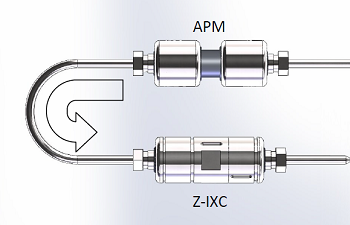
The role of the auxiliary processing module (APM) is to act as premixing or pre-processing module that is located upstream of the smaller geometry of the Z-type IXC.
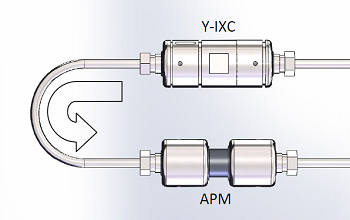
The auxiliary processing module (APM) also stabilizes the fluid flow by acting as an intermediate pressure relief between the high pressure IXC and the atmosphere.
OPTIMUM PERFORMANCE
Genuine OEM Interaction Chambers™
Over time and after prolonged use, Interaction Chambers™ will begin to wear. Flow rates gradually increase until the chamber can no longer reach maximum pressure. Microfluidizer® Processors are designed to compensate for up to 20% wear before maximum pressure can no longer be maintained.
To keep your system running at peak performance, we recommend replacing worn chambers with genuine OEM parts. Using genuine Microfluidics parts maintains optimum efficiency and ensures your process results stay consistent batch after batch.
Commonly stocked chambers include:
Y-Type Interaction Chambers™
F12Y, F20Y, J20Y, J30Y
Z-Type Interaction Chambers™
G10Z, H10Z, L10Z, L10Z, H210Z, H30Z, L210Z, L30Z, H230Z, Q50Z, T50Z, T60Z, T250Z

Microfluidics offers a full range of aftermarket services to keep your processor in optimal operating condition.

INTERACTION CHAMBERS
FAQs
An Interaction Chamber™ is the core processing component inside a Microfluidizer® Processor. It is a precision-engineered microchannel through which fluid is forced at extremely high pressure and velocity. The resulting shear, impact, and turbulence forces break down particles and droplets to nanoscale sizes.
The geometry of the Interaction Chamber™ directly controls the shear forces applied to the fluid being processed. The smaller the microchannel the higher the shear rate created, which drives finer particle size reduction. Microfluidics engineers can match chambers to applications, so you are not guessing at settings or getting the wrong results.
Because every mL of fluid passes through the same fixed-geometry channel, the process is highly repeatable. The same high shear processing rates are present in both the single and multi-slotted chambers, ensuring that results achieved in the lab are the same at larger production scale. To scale up the process multiple microchannels are placed in parallel, which increases the flow rates.
You should consider replacing your Interaction Chamber™ when flow rates increase noticeably or when your processor can no longer reach maximum operating pressure. Microfluidizer® Processors are built to tolerate up to 20% chamber wear, but once performance drops below this threshold, replace the chamber with a genuine OEM part to restore full processing capability.
Different applications often require different chamber geometries. For example, the Y-Type chamber is suited to emulsions, liposomes, and polymer encapsulations, while the Z-Type chamber is preferred for cell disruption, dispersions and de-agglomeration. Our team can help you select the right chamber for each application.
The Y-Type chamber uses a design where two fluid streams collide, making it well suited for emulsions, liposomes, and polymer nanoparticles. The Z-Type chamber forces the fluid through a series of sharp directional changes, generating very high and uniform shear for cell disruption, dispersions and de-agglomeration. The Z-Type is typically paired with an APM for demanding formulations that require extremely tight particle size control.
Yes. Our team works directly with customers to identify the best Interaction Chamber™ for their specific process and formulation. You can also explore our aftermarket support resources or contact the Aftermarket Team using the form on this page.
Using non-genuine replacement chambers can lead to inconsistent shear rates, reduced process performance, and potential damage to your processor. Genuine Microfluidics OEM chambers are manufactured to the same tolerances as the original components, which protects both your equipment and your formulation outcomes.