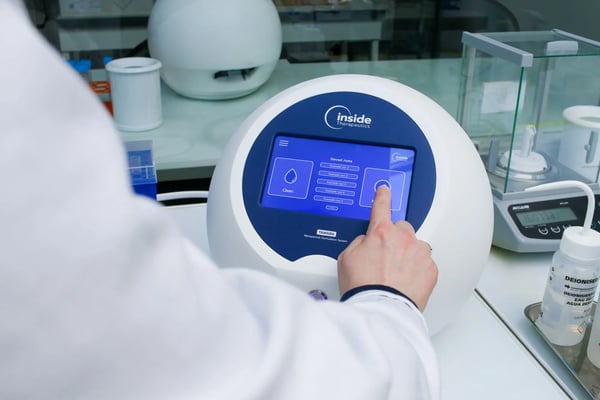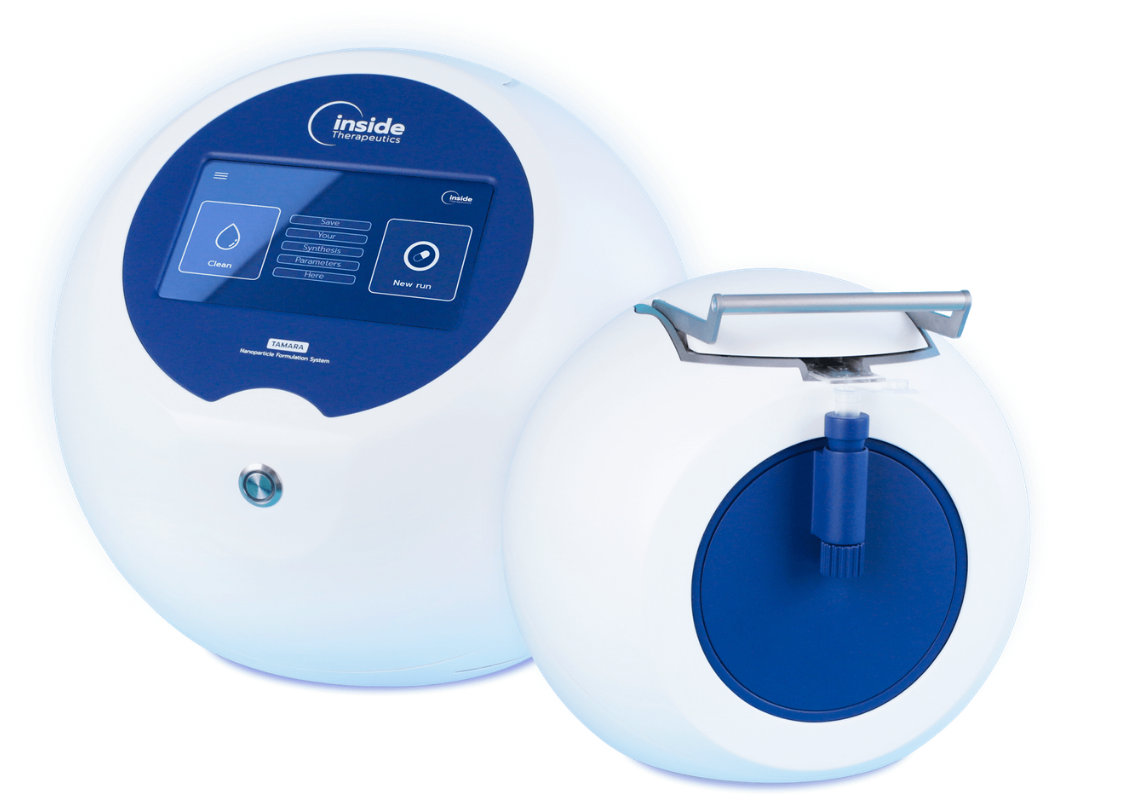




Nanoparticle Formulation System
A simple benchtop machine for formulating lipid nanoparticles
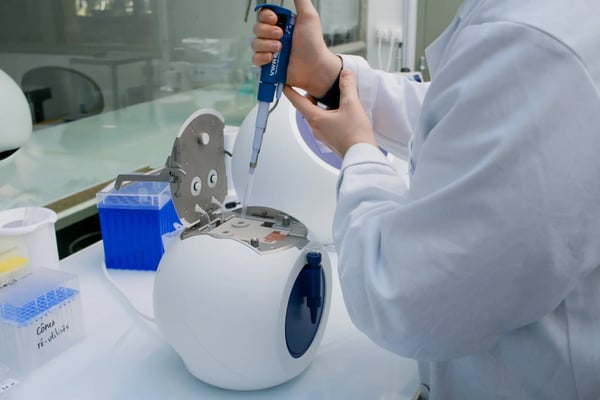
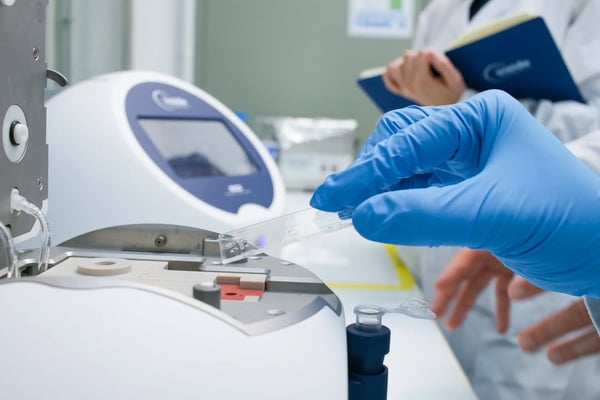
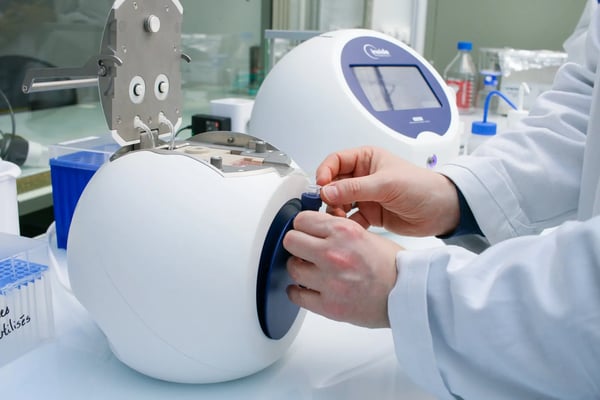
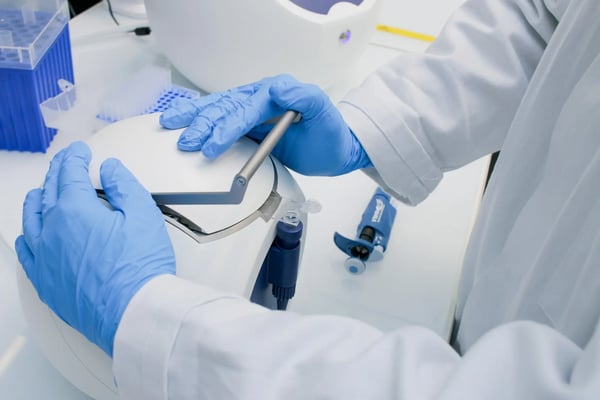
TAMARA is a lab-scale RNA-LNP formulation system that uses microfluidics to synthesize nanoparticles, enabling you to streamline your research and development in lipid-based nanoparticles such as LNPs, liposomes and PLGAs.
TAMARA is the only platform that offers a comprehensive R&D system covering low volumes for screening (200µL) all the way up to in-vivo scale production (30mL batches). Its innovative fluidic design eliminates head & tail losses, resulting in zero formulation loss.
Simple to use with an easy plug & play 3-step set up, samples can be processed with TAMARA in under 2 minutes. Reusable microfluidic chips make it a sustainable choice with low cost per run.
Microfluidics™ is partnering with Inside Therapeutics to bring TAMARA to the R&D community in the USA & Canada.

Key Features
Tailored for RNA-LNP formulation
One platform offering 200µL screening to 30mL in-vivo volumes
Re-usable microfluidic chips & reservoirs
Head & tail losses eliminated with an innovative fluidic design
Fast processing: < 2 minutes per run
Benefits
One platform for all R&D nanoparticle formulations
Quick & efficient with fast routines
Effortless and intuitive operation
Controlled nanoparticle synthesis with optimal sample usage
Minimize cost per run with reusable chips
Maximized RNA & API usage - zero formulation loss
What TAMARA Does
.webp?width=600&height=414&name=Chip-with-descriptions-1%20(1).webp)
A versatile solution for lipid-based and polymeric nanoparticle synthesis.
Because the nanoparticle acts as the delivery system for the Active Pharmaceutical Ingredient (API) or mRNA, gaining consistency in particle characteristics is essential. The size, PDI (Polydispersity Index), and EE% (Encapsulation Efficiency) are critical in determining the particle payload and affect the interaction with cells & tissues. Even a small difference in these parameters can create different results in terms of drug delivery and efficiency.
Nanoparticle size is critical, as too large can lead to liver clearance & kidney filtration, while too small can be toxic. TAMARA offers a unique ability to finely control the nanoparticle size because it delivers a faster mixing time. Using the most advanced microfluidics technology, a PDI <0.2 for RNA-LNP is achievable.
The encapsulation efficiency relates to the ability of the nanoparticle to encapsulate the drug, which is defined as the trapped drug over the total amount of formulation. The microfluidics used in the TAMARA platform provide the highest levels of efficiency, reaching 98% EE of RNA into LNP.
Application Note
TAMARA makes nanoparticle and LNP research simple and reliable for both new and experienced users, using advanced microfluidics to tightly control particle size, PDI, and encapsulation efficiency.
Read the Application Note to discover how TAMARA offers streamlining of screening & compares to other methods.
.webp?width=350&height=350&name=TAMARA-AppNote-Front-Cover-Widget%20(1).webp)
TAMARA
Frequently Asked Questions
TAMARA is an R&D scale system that uses microfluidic technology to create RNA-LNP formulations.
The TAMARA RNA-LNP formulation system from Inside Therapeutics delivers high performance microfluidic synthesis of lipid nanoparticles (LNPs) with mRNA or siRNA payloads. It enables researchers to reliably produce uniform nanoparticles with >98% encapsulation efficiency in under 2 minutes, from low volume screening batches (200 µL) through to in vivo–scale runs (up to 30 mL).
TAMARA works by using advanced microfluidic chips to precisely mix the lipid–solvent and aqueous RNA phases under pressure-driven control.
Through controlled nanoprecipitation, TAMARA manages the four key stages of LNP formation—supersaturation, nucleation, growth, and stabilization—to deliver consistent particle quality. The system is engineered to minimise waste (no head or tail losses), so almost 100% of the active ingredient (API/RNA) is encapsulated, even at low volumes.
The TAMARA nanoparticle formulation system processes volumes from 0.2 mL (200 µL) up to 30 mL per batch. The system is designed for optimal efficiency, with guaranteed accuracy and repeatability across sample volumes from 0.5 to 5 mL.
TAMARA uses best in class pumps and advanced microfluidic chips to precisely accurately control the mixing conditions that impact encapsulation efficiency. The system allows for fine-tuning of Total Flow Rate (TFR) and Flow Rate Ratio (FRR), resulting in a low polydispersity index (<0.2) and optimal nanoparticle size (~50–200 nm), directly correlating to high efficiency.
TAMARA completes individual sample formulation in under 2 minutes. For very low formulation volumes, the actual formulation runtime can be as short as ~3 seconds.
TAMARA is the only Microfluidic system that allows for precise low volume screening AND volumes sufficient for In-Vivo testing on the same device. It is the easiest to use because it doesn’t require syringes and most reproducible because it has recipe control capabilities.
TAMARA has also been proven to be able to create liposomes and polymer nanoparticles with very small size and low polydispersity.
TAMARA generates particles with low polydispersity index (<0.2) and optimal nanoparticle size (~50–200 nm), directly correlating to high efficiency.
TAMARA offers scale up to 30 mL which is sufficient for In-Vivo testing. Scale up from Microfluidic Chips to production volumes is generally avoided. Once the In-Vivo studies are completed, the process can be scaled up using conventional production processes like T-Mixers.
The TAMARA nanoparticle formulation system is the only system that is able to work with volumes as low as 200 uL and up to 30 mL. It is ideally suited to R&D research of its simplicity and reproducibility.
TAMARA also delivers best in class results; up to 98% encapsulation efficiency, excellent size control, highly uniform RNA-LNP particles, and up to 30% higher protein expression than conventional mixers.
It saves time and money by eliminating loss of valuable raw materials, using reusable low-cost chips. TAMARA combines two microfluidic designs on one chip so users can choose the best approach for their needs, providing an all-in-one system that replaces multiple machines from research through preclinical scale-up.
Testimonial
"We are really satisfied with the Tamara. We have been using it to produce different LNP formulations with up to 4 components for over 1 year.
"The system has proven reliable for optimizing particle size and other key characteristics, delivering highly reproducible results even at low formulation volumes."
Wook-Jin Park, Ph.D.
Postdoctoral Fellow
The Weissman Lab - Perelman School of Medicine
Penn Institute for RNA Innovation
University of Pennsylvania, USA
Microfluidic Technology
Multiple methods can be used to mix fluids in a microfluidic chip. With the TAMARA platform, there are
two designs in one - simply rotate the chip to interchange between the mixer types.
Herringbone Mixer
This is the most commonly used format for micromixers as it offers the best flexibility in mixing time control, which dictates the size of the nanoparticles produced. It provides not only repeatability and uniformity, but also a large flow rate range which works with small & large volumes.
The mixing relies on the creation of micro-vortices in a ridged microchannel, where the two streams of reagent are injected. These induce a folding of the 2 liquid phases in on themselves, increasing the exchange surface between the 2 phases.

Baffle Mixer
The Baffle Mixer is offered as an alternative as it provides faster mixing using Dean vortices with higher pressure on the outside of the bend and lower pressure on the inner side providing centripetal acceleration for the flow to follow the curve.
This mixer method enables smaller nanoparticles to be produced at a higher total flow rate compared to Herringbone mixing.
RESOURCES
Articles - Nanoparticles Reviews
Learn more about lipid nanoparticles and formulation methods with the following articles.